
TecGeetha Certified Professional Program in CFD Simulation
Industry-oriented training in computational fluid dynamics covering fluid flow, heat transfer, turbulence, multiphase systems, meshing, solver setup, post-processing and engineering interpretation using ANSYS Fluent and OpenFOAM.
Build Practical CFD Skills for Real Engineering Applications
This professional program is designed for engineering students, fresh graduates and working professionals who want to develop practical CFD simulation skills using ANSYS Fluent and OpenFOAM.
The program combines fluid mechanics, heat transfer, turbulence modelling, meshing, numerical methods, solver setup, convergence assessment, post-processing and engineering interpretation.
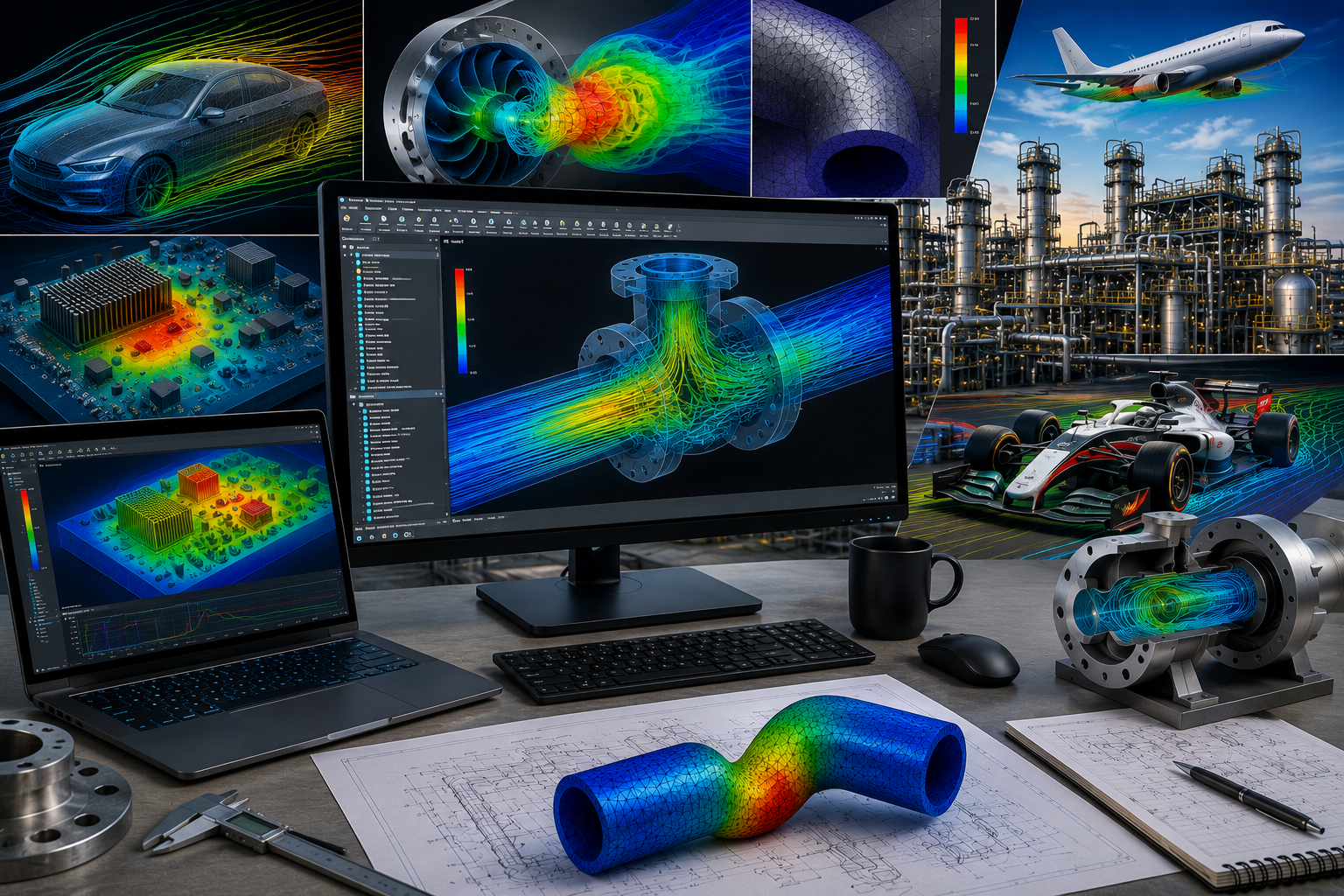
Program Coverage
This comprehensive professional training program covers:
- Introduction to CFD and Engineering Applications
- Fluid Mechanics and Heat Transfer Fundamentals
- Governing Equations and Numerical Methods
- Geometry Preparation and Mesh Generation
- Boundary Conditions and Material Properties
- Solver Setup and Solution Controls
- Laminar and Turbulent Flow Simulation
- Internal and External Flow Analysis
- Heat Transfer and Thermal Analysis
- Multiphase Flow Fundamentals
- Mixing, Agitation and Rotating Systems
- Species Transport and Dispersion
- Convergence, Validation and Mesh Independence
- ANSYS Fluent and OpenFOAM Training
- Industrial Case Studies and Final Capstone Project
- Final Examination, Certification and Placement Assistance
Software Covered
Practical simulation training across commercial and open-source CFD platforms.
ANSYS Fluent
- Geometry and mesh workflow
- Turbulence, heat transfer and multiphase models
- Rotating systems and species transport
- Convergence monitoring and post-processing
OpenFOAM
- Case structure and solver selection
- Mesh setup and boundary conditions
- Running, monitoring and troubleshooting cases
- ParaView post-processing and result extraction
Simulation Applications Covered
CFD applications across process, automotive, aviation, electronics, pharmaceutical and building industries.
Fluid Flow Analysis
Internal and external flow, pressure drop, velocity distribution, recirculation, dead zones and flow maldistribution.
Heat Transfer & Thermal Management
Forced and natural convection, conjugate heat transfer, hotspots, electronics cooling, batteries, heat sinks and cold plates.
Mixing & Agitation
Agitated vessels, impeller performance, mixing time, dead zones, baffle comparison and pharmaceutical mixing applications.
Multiphase Flow
Gas–liquid, liquid–liquid, solid–liquid, slurry flow, particle tracking, sprays, sedimentation and free-surface analysis.
Automotive Applications
Vehicle aerodynamics, underbody flow, drag assessment, engine-bay cooling, battery thermal management and HVAC airflow.
Aviation & Aerospace
External aerodynamics, wing and component airflow, aircraft cabin ventilation, avionics cooling, intakes and ducts.
Electronics Cooling
PCB thermal assessment, enclosure ventilation, server racks, data centres, heat sinks and electrical-panel cooling.
Pharmaceutical Applications
Cleanroom airflow, contamination control, reactor mixing, sterile-room ventilation and process-equipment performance.
Ventilation & HVAC
Indoor airflow, thermal comfort, industrial ventilation, smoke movement and HVAC air-distribution studies.
CFD Methodology
A structured workflow from model preparation to engineering recommendations.
Geometry Preparation
CAD cleanup, fluid-domain extraction, simplification and boundary definition.
Meshing
Element selection, local refinement, boundary layers, mesh quality and independence checks.
Solver Setup
Materials, boundary conditions, physical models, numerical schemes and convergence controls.
Results & Interpretation
Contours, streamlines, balances, design comparison and engineering recommendations.
Practical Industrial Case Studies
Application-focused examples from multiple engineering sectors.
- Pressure drop in piping systems
- Flow through valves and fittings
- Agitated tank and pharmaceutical reactor mixing
- Separator and cyclone performance
- Heat-transfer equipment analysis
- Automobile aerodynamics and engine-bay cooling
- Aircraft external flow and cabin ventilation
- Avionics and electronics cooling
- Battery thermal management
- Data-centre airflow
- Cleanroom airflow and contamination control
- HVAC air distribution
- Gas dispersion and particle erosion
- Pump or fan internal flow
- Process equipment optimization
Industry Capstone Project
Complete a guided CFD engineering project covering problem definition, geometry preparation, meshing, physical-model selection, solver setup, convergence assessment, post-processing, design comparison and final engineering report preparation.
Who Should Join?
Suitable for students, graduates and professionals seeking CFD and CAE careers.
- Mechanical Engineering Students
- Chemical Engineering Students
- Aerospace Engineering Students
- Automotive Engineering Students
- Production and Petroleum Engineering Students
- Civil and Environmental Engineering Students
- Fresh Engineering Graduates
- Design and Process Engineers
- Thermal and HVAC Engineers
- Equipment Engineers
- CAE and R&D Professionals
- Working Professionals Seeking CFD Skills
Career Opportunities
The program supports preparation for roles across simulation, product development and engineering consulting.
CFD Engineer
CAE Engineer
Thermal Engineer
Fluid Systems Engineer
Automotive CFD Engineer
Aerospace CFD Engineer
Electronics Cooling Engineer
R&D Engineer
Related Professional Programs
Continue building multidisciplinary engineering capability with TecGeetha.
FEA
View ProgramStatic Equipment Design
View ProgramPiping Engineering
View ProgramAspen Plus / HYSYS
View ProgramBuild Your Career in CFD Simulation
Develop practical skills in fluid flow, heat transfer, turbulence, multiphase systems, meshing, solver setup and engineering interpretation using ANSYS Fluent and OpenFOAM.