
TecGeetha Certified Professional Program in Finite Element Analysis
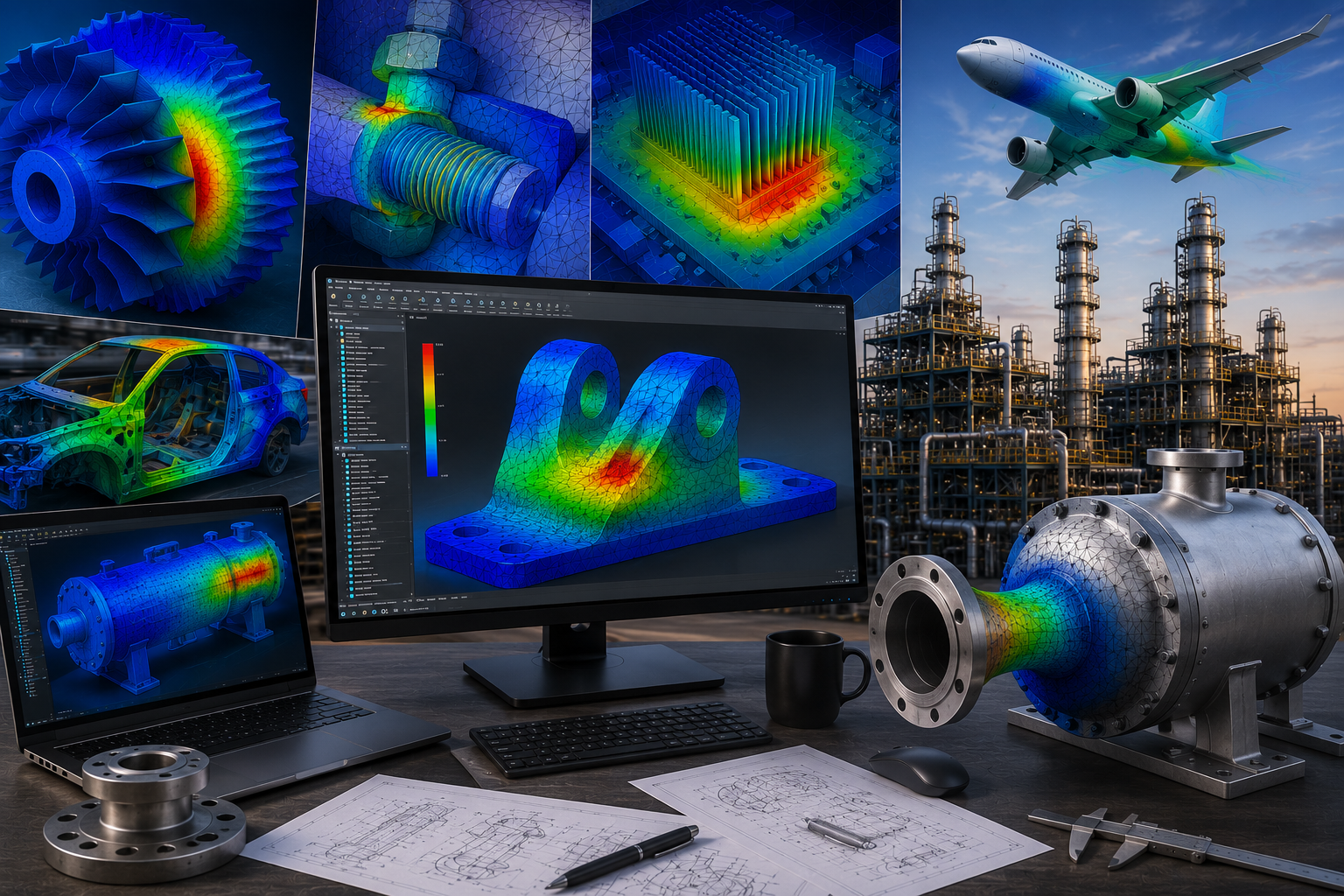
Industry-oriented training in structural, thermal, fatigue, vibration, buckling, contact and nonlinear analysis using ANSYS Mechanical and Abaqus, supported by practical engineering case studies and project-based learning.
Build Practical FEA Skills for Real Engineering Applications
This professional program is designed for engineering students, fresh graduates and working professionals who want to develop practical finite element analysis skills using ANSYS Mechanical and Abaqus.
The course combines solid mechanics, material behaviour, meshing, structural analysis, thermal analysis, nonlinear simulation, fatigue, buckling, vibration and engineering interpretation.
Program Coverage
This comprehensive professional training program covers:
- Introduction to Finite Element Analysis
- Engineering Mechanics and Strength of Materials
- Finite Element Theory and Numerical Fundamentals
- Geometry Preparation and Model Simplification
- Element Types, Meshing and Mesh Quality
- Material Properties, Loads and Boundary Conditions
- Linear Static Structural Analysis
- Thermal and Thermal-Stress Analysis
- Contact and Bolted Joint Analysis
- Nonlinear Structural Analysis
- Plasticity and Large Deformation
- Buckling Analysis
- Modal, Vibration and Harmonic Response
- Fatigue Assessment
- ANSYS Mechanical and Abaqus Training
- Industrial Project, Final Examination, Certification and Placement Assistance
Software Covered
Practical training across two widely used finite element analysis platforms.
ANSYS Mechanical
- Geometry, materials and contacts
- Structural and thermal analysis
- Modal, fatigue and buckling studies
- Nonlinear analysis and result interpretation
Abaqus
- Part and assembly modelling
- Material, contact and step definition
- Static, nonlinear and plasticity analysis
- Large deformation and result visualization
Analysis Types Covered
FEA workflows for major structural, thermal and dynamic engineering problems.
Linear Static Analysis
Stress, strain, deformation, stiffness, load paths and allowable-stress verification.
Nonlinear Analysis
Material, geometric and contact nonlinearities, plastic deformation and large-deflection behaviour.
Thermal Analysis
Steady-state, transient thermal, heat flux, gradients, expansion and thermal-stress assessment.
Fatigue Analysis
Stress-life, strain-life, thermal fatigue, fatigue damage and design-life estimation.
Buckling Analysis
Eigenvalue and nonlinear buckling, critical loads and thin-structure stability assessment.
Modal & Vibration Analysis
Natural frequencies, mode shapes, resonance, harmonic response and dynamic amplification.
Industrial Applications Covered
FEA applications across process equipment, automotive, aerospace, manufacturing, civil and electronics sectors.
Pressure Vessels & Static Equipment
Pressure vessels, heat exchangers, nozzles, supports, saddles, lifting lugs and local-stress evaluation.
Automotive Engineering
Chassis, suspension, brake components, engine mounts, fatigue, vibration and structural validation.
Aerospace & Aviation
Lightweight structures, brackets, thermal-structural response, vibration and buckling of thin components.
Manufacturing & Machinery
Machine frames, base plates, housings, brackets, rotating-equipment supports and industrial parts.
Civil & Structural Components
Steel frames, platforms, pipe racks, base plates, anchors and equipment-support structures.
Electronics & Thermal Systems
Heat sinks, enclosures, battery housings, PCB supports and thermo-mechanical stress evaluation.
FEA Methodology
A structured workflow from geometry preparation to engineering recommendations.
Geometry Preparation
CAD cleanup, simplification, symmetry and shell, beam or solid idealization.
Meshing
Element selection, refinement, contact meshing, quality checks and mesh-independence assessment.
Model Setup
Materials, loads, constraints, contacts, analysis settings and solver controls.
Results & Interpretation
Stress, deformation, temperature, contact pressure, modes, fatigue life and recommendations.
Industry Capstone Project
Complete a guided FEA engineering project covering problem definition, geometry preparation, material selection, meshing, load and boundary-condition definition, contact setup, convergence assessment, result interpretation and final engineering report preparation.
Who Should Join?
Suitable for students, graduates and professionals seeking careers in FEA and CAE.
- Mechanical Engineering Students
- Aerospace Engineering Students
- Automotive Engineering Students
- Civil Engineering Students
- Production and Industrial Engineering Students
- Fresh Engineering Graduates
- Design and Mechanical Engineers
- Structural and Static Equipment Engineers
- Product Development Engineers
- CAE Engineers
- R&D Professionals
- Working Professionals Seeking FEA Skills
Career Opportunities
The program supports preparation for roles across simulation, product development and engineering consulting.
FEA Engineer
CAE Engineer
Structural Analysis Engineer
Mechanical Design Engineer
Stress Engineer
Fatigue Engineer
Automotive CAE Engineer
Aerospace Structural Engineer
Related Professional Programs
Continue building multidisciplinary engineering capability with TecGeetha.
CFD Simulation
View ProgramStatic Equipment Design
View ProgramPiping Engineering
View ProgramHTRI Thermal Design
View ProgramBuild Your Career in Finite Element Analysis
Develop practical skills in structural, thermal, fatigue, vibration, buckling, contact and nonlinear analysis using ANSYS Mechanical and Abaqus.